Your best-fit buyer just asked ChatGPT who to hire. Your name wasn’t in the answer.
A quiet, expensive shift is happening in B2B. Buyers stopped opening ten browser tabs. They opened one chat window instead — and whatever the AI says about your category is now the shortlist. This is a look at why that shortlist is being written without you, and what it takes to get on it.
5.0/5 on Clutch·4.8/5 on G2·4.5/5 on Trustpilot·500M+ AI search queries every week
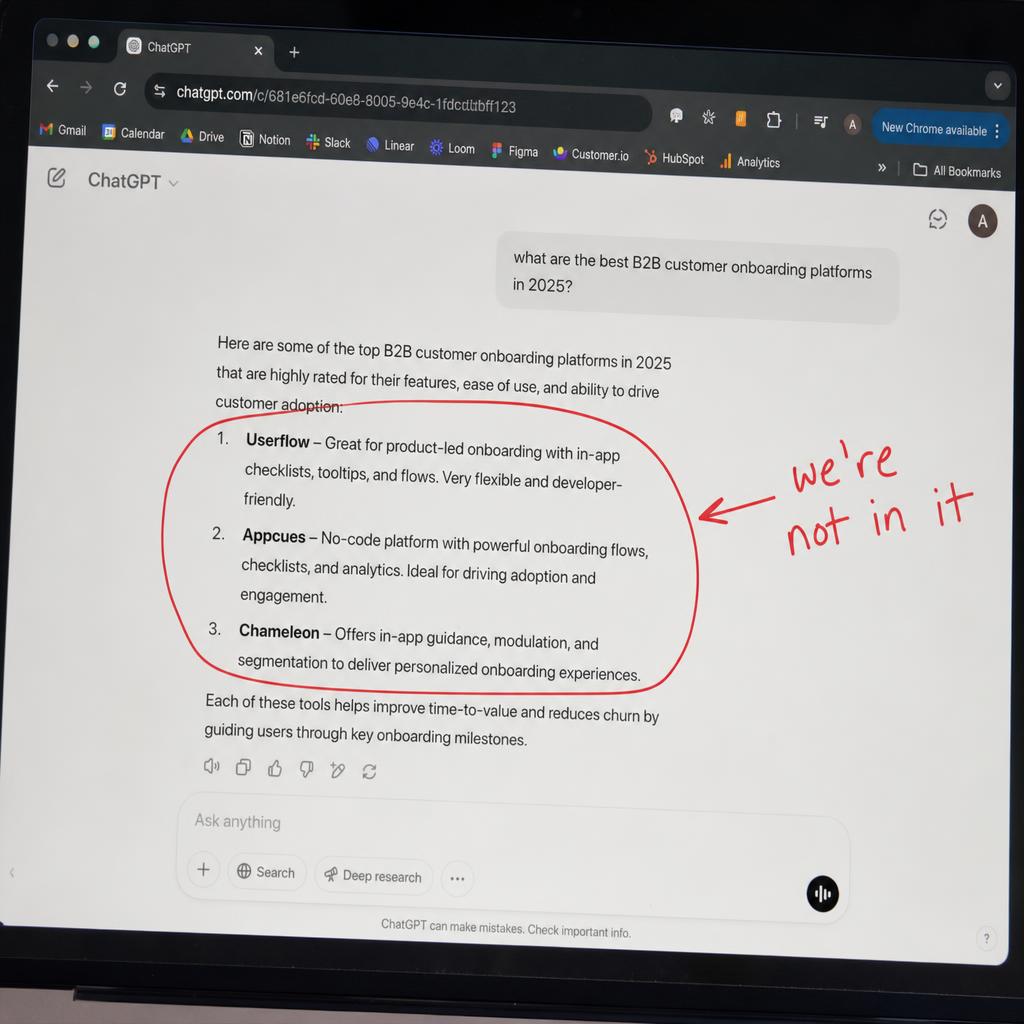
Illustration: a ChatGPT answer to “best tools for [category] in 2025” listing three competitors in a numbered list, with a hand-drawn red pen circle around the blank space where the client’s name should have been.
A founder we work with pulled us into a Slack call last winter. He was confused. His pipeline had softened for two quarters in a row. Nothing in the paid channels explained it. Rankings on Google looked normal. Impressions were fine. Content calendar on schedule.
Then he asked us to run one test. Open ChatGPT. Type the exact phrase a buyer would type at the start of their evaluation. Something like: “What are the best tools for X in 2025?”
Three brands came back. All competitors. His company — the one with the better product, better reviews, and more capital — was not on the list. It was as if he had been erased from the buyer’s first draft of a shortlist he never even got to see.
That is the actual problem. Not rankings. Not clicks. Being present in the answer that decides who gets considered at all.
“Measured, brand-safe execution with reporting tied to outcomes. A reliable growth partner.”
Rob Wiesenthal · CEO, Blade Air Mobility
What most teams still get wrong
SEO trained a generation of marketers to optimize for the wrong reader.
For twenty years, the reader we all wrote for was a person. A person scanning ten blue links, judging your meta description, deciding whether to click. Every playbook — keywords, backlinks, site speed, E-E-A-T — was built around persuading that person to click through and read.
The reader has changed. In most B2B categories, the first “click” a buyer makes now happens inside a language model. They ask a question. They read a synthesized answer. They walk away with a shortlist of three or four names. Only after that do they open a browser — and by then, most of the decision is already made.
You are no longer optimizing content for a human clicking a link. You are optimizing signals for a model deciding which brand to name. Those are different jobs. Same industry, different job.
This is why teams pouring more into blog production, more backlinks, or another SEO retainer keep getting the same result. Not because the work is bad. Because the work is aimed at a reader who has quietly left the building.
Who this is for
You will get more out of the next 8 minutes if this sounds like you.
A fit
— You run growth or marketing at a B2B SaaS or ecommerce brand.
— You have a real product, real customers, and reviews you’re proud of.
— You suspect AI-driven search is already reshaping how buyers find you.
— You want measurable AI citations, not a vague “presence.”
Not a fit
— You want a set-it-and-forget-it hack that skips the fundamentals.
— You expect results in two weeks and refuse to work with a partner.
— You’re shopping for the cheapest “AI SEO” retainer on the market.
— Your product isn’t ready to defend the attention it would attract.
The method
The Citation Loop — how a brand becomes an answer, not a result.
Getting cited by AI is not one trick. It is a loop of three signals a language model uses to decide who to name. Miss one, and you stay invisible. Get all three working together, and your brand starts showing up in answers your competitors don’t even know are being given.
01
Make yourself legible to the model.
Here’s the analogy I use with founders on the first call. Imagine your category is a dinner party, and the AI is the host introducing guests to each other. The host doesn’t read your website. The host reads a name tag. Whatever is on that name tag — two lines, maybe three — is what everyone else in the room hears about you.
Most B2B sites do not have a name tag. They have a mood board. Clever taglines, vague headers, product pages padded with adjectives that were written to make a human feel something. Language models don’t feel anything. They parse. They look for clean, structured statements they can lift into an answer without having to guess.
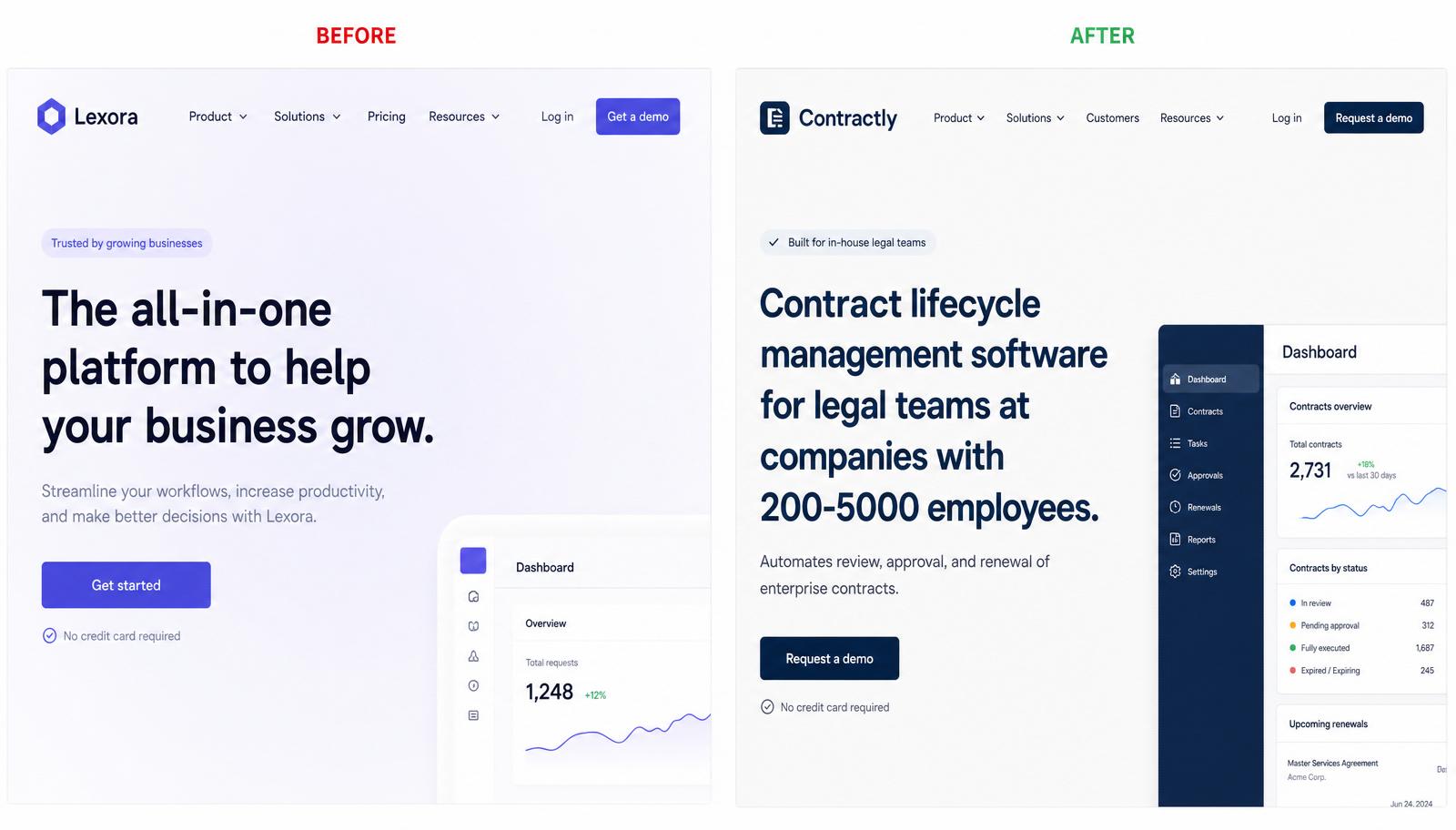
The first time we ran this test on a client — a Series B SaaS company with a very good product — we asked ChatGPT to describe them in one sentence. It came back with something like “an all-in-one platform that helps businesses grow.” That was their tagline. Verbatim. The model had nothing else to work with, so it just handed the tagline back. Meanwhile, their two closest competitors got described in specific, verb-driven sentences that actually explained the job they did.
Illustration: a two-panel before/after mock-up of a B2B product page hero. Left panel shows vague adjective-heavy copy (“an all-in-one platform that helps businesses grow”); right panel shows the same section rewritten as a specific, verb-driven definition of the job the product does.
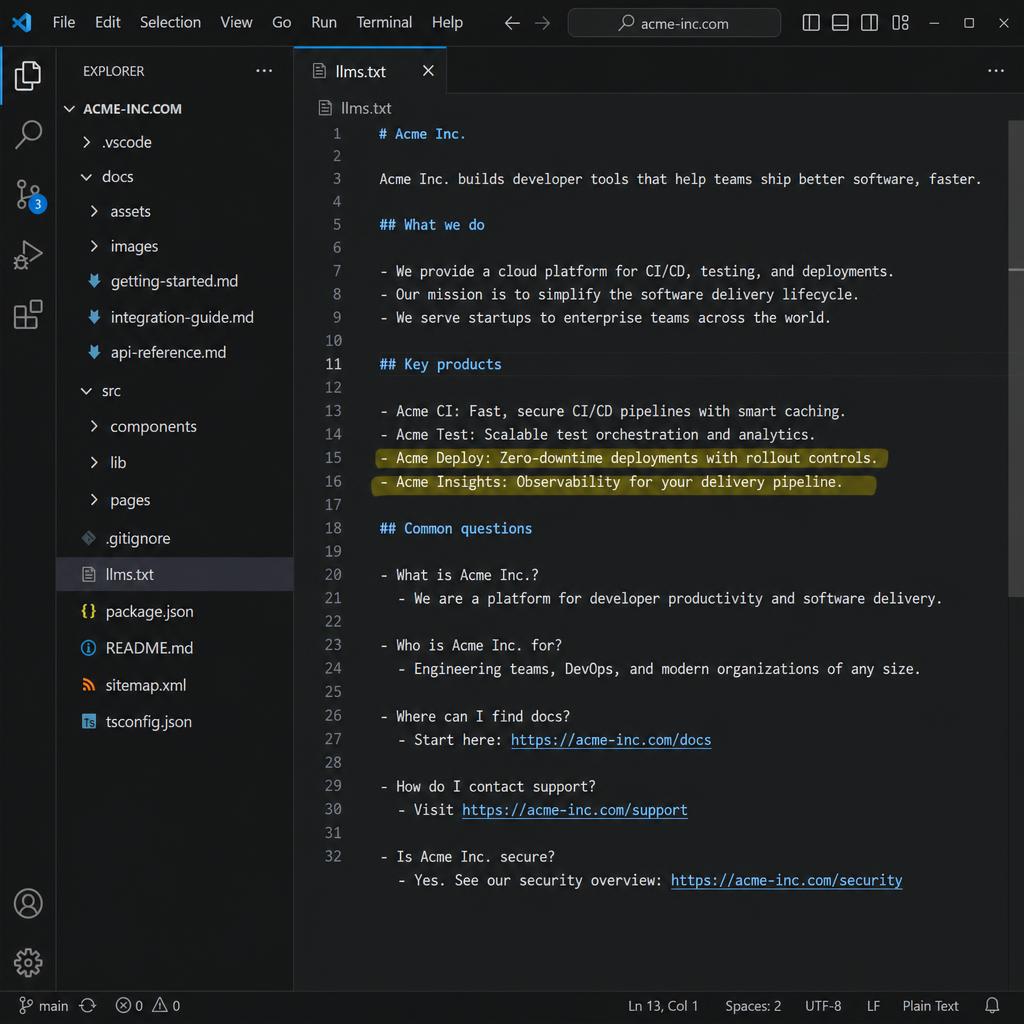
So the first thing we do is boring and technical, and it is the thing almost nobody wants to pay for: we rewrite the parts of your presence that a model reads first. Schema markup that says exactly what you are. Entity definitions that tie your brand to the specific problem, category, and buyer you serve. An llms.txt at the root of your domain that acts like a briefing document for every crawler: this is who we are, this is what we sell, this is who it’s for, these are the questions we’re a real answer to.
Then we go through your top product and category pages and quietly rewrite them into a structure the model can actually quote — short, factual Q&A blocks, comparison paragraphs with clear subjects and objects, definitions that read like an entry in a reference book rather than a headline in an ad. This is not more content. It is content the model can pull cleanly into an answer without having to invent the words itself.
The result, three to six weeks in, is that you stop being described as “a platform” and start being described as the specific answer to the specific question your buyer is typing. That single shift — from adjective to answer — is what puts your name back into the running.
✦Operator's takeaway
If a language model cannot describe what you do in one specific sentence, your buyer will not see your name in the answer. Clarity beats cleverness in the AI shortlist.
02
Build the entity graph the model already trusts.
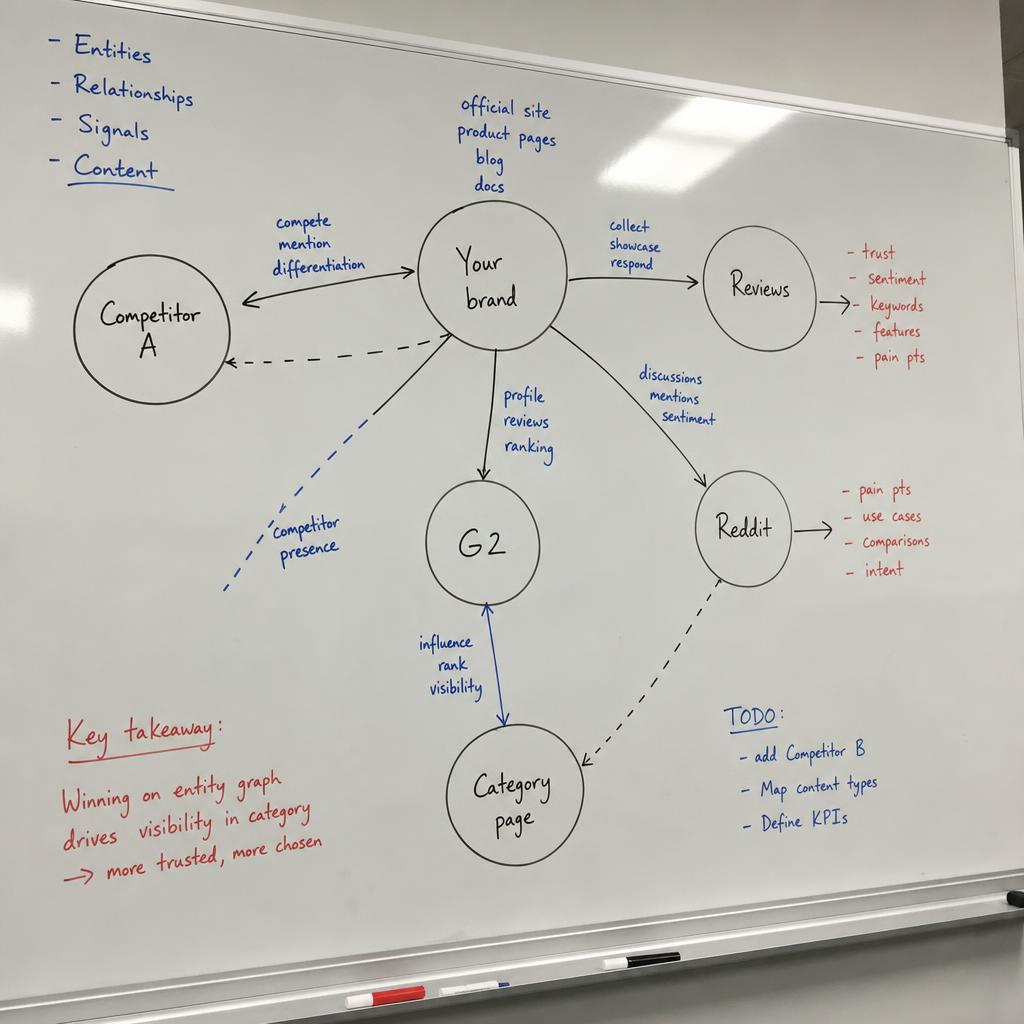
If step one is your name tag, step two is your reputation in the room. The model doesn’t evaluate you in isolation. It evaluates you inside a graph — a web of who talks about you, in what context, next to which competitors, using what language, and with what sentiment. When that graph is thin, out of date, or dominated by the wrong signals, no amount of on-site work will move you into the answer.
Think of it the way an executive recruiter thinks. Before they put your name on a shortlist, they don’t read your CV. They call three people who’ve worked near you and ask what you’re actually like. The model is doing the same thing, at scale, in milliseconds. It’s asking: which sources already have opinions on this brand, and do those opinions agree?
This is where most “AI SEO” services quietly fall apart. They audit your website, hand you a checklist, and stop. But your website is maybe 20% of the signal. The other 80% lives on third-party surfaces — category pages, review sites, comparison articles, industry roundups, forum threads, podcast transcripts, YouTube descriptions — the sources retrieval systems weight most heavily when they piece an answer together.
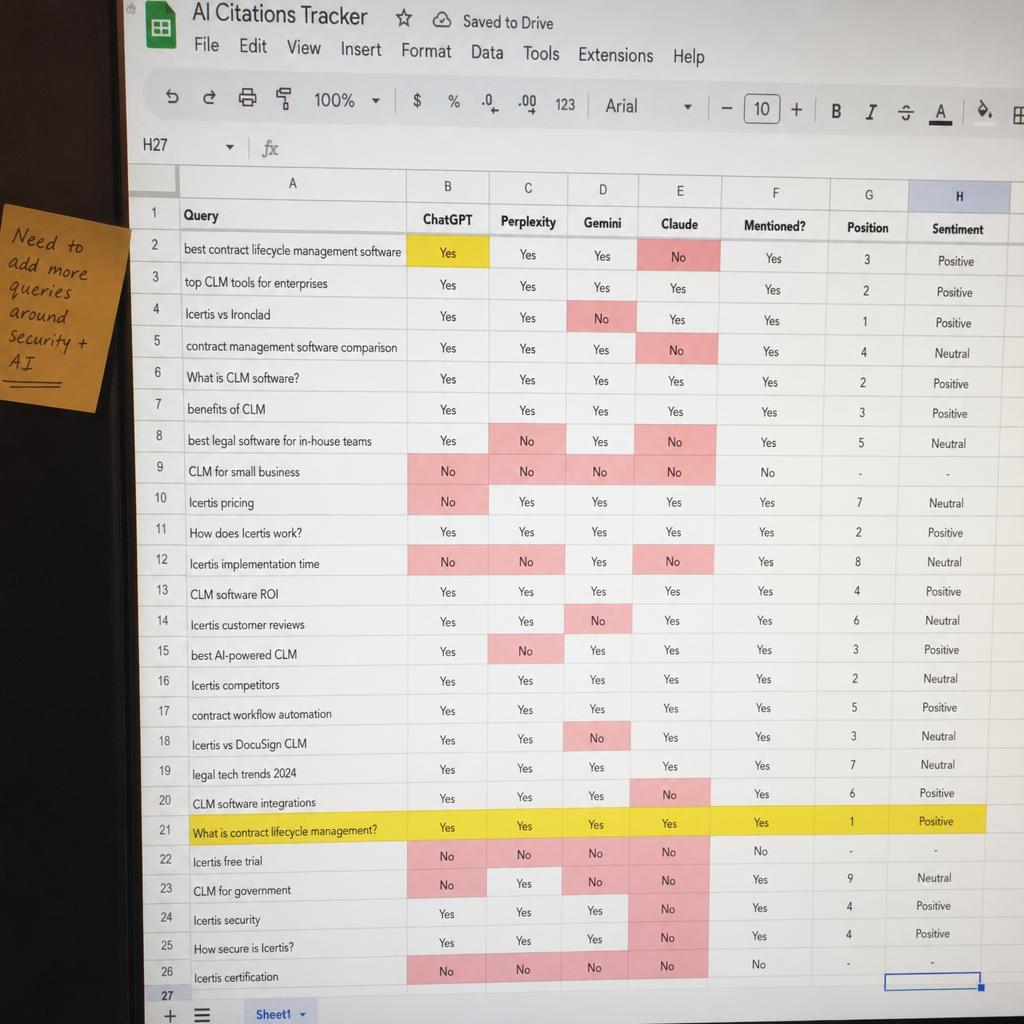
Illustration: a spreadsheet-style tracker with buyer queries down the left column and ChatGPT, Perplexity, Gemini and Claude across the top, each cell marked “Yes” or “No” depending on whether the brand is cited — the shape of the reporting we build inside an engagement.
So we start with a map. We plot your brand, your competitors, and every source the model is currently reaching for when it answers questions in your category. Then we score each node: is it there, is it missing, is it saying the wrong thing, is it saying nothing at all? That map becomes the plan for the quarter — a specific, prioritized list of citations we need to earn, refresh or reframe.
Then we go do the work. Not spam. Not paid placements dressed up as editorial. We pitch the analysts who write the category pages. We contribute to the comparison articles that already rank. We get you into the round-ups your buyers screenshot and send to their boss. Everything auditable, on real domains, in a way that stands up to a general counsel review.
After a few months of this, something clicks. The model starts describing you inside the same “neighborhood” as the category leaders, because in its training and retrieval signals, you now are. When a buyer asks “top providers of X,” you’re inside the small set of names the model is choosing from — not fighting to break in from outside.
✦Operator's takeaway
Your website is maybe 20% of the signal. The other 80% is what the model finds about you on the independent sources it already trusts. Build there.
03
Feed the loop with real conversations.
The last signal is the one most teams underrate, and it’s the one that compounds hardest. Independent human conversation about your brand. Honest reviews. Comparison threads on Reddit. Unprompted recommendations in Slack communities, in Substack posts, in podcast rundowns, in the “what do you use for X” question that gets asked in every industry group every week.
These are exactly the sources retrieval systems trust most, because to the model they look unpaid and unedited. A Reddit thread where three strangers agree your product is the right pick for a 20-person team is worth more, to a language model constructing an answer, than a page of glossy testimonials on your own website. It’s the same reason you trust a friend’s offhand recommendation more than an ad — the model was trained on the same instinct.
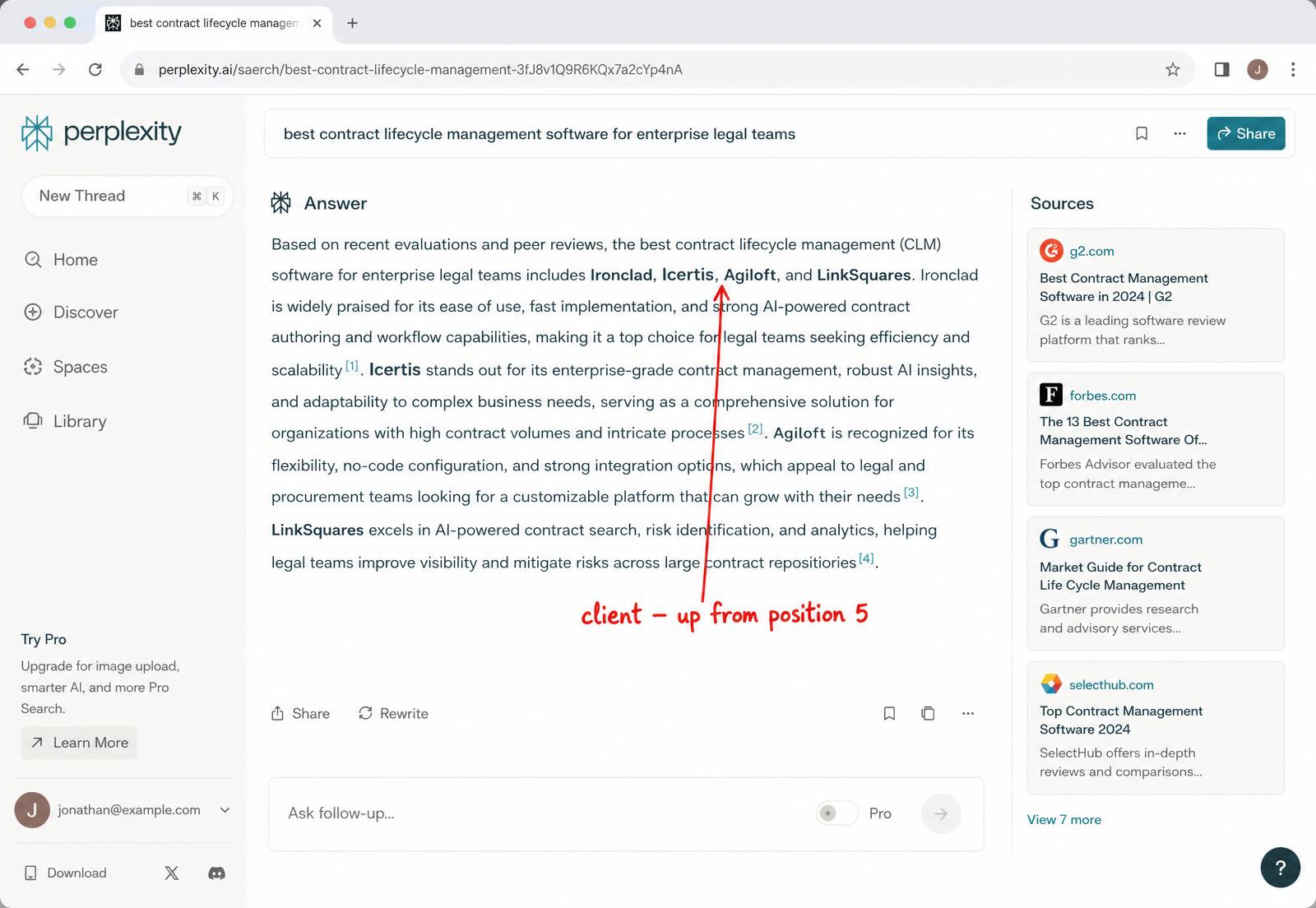
Illustration: a Perplexity answer to the same category query with four numbered source citations underneath, showing what it looks like when a brand moves from “not cited at all” to being named alongside category leaders with independent sources feeding the citation.
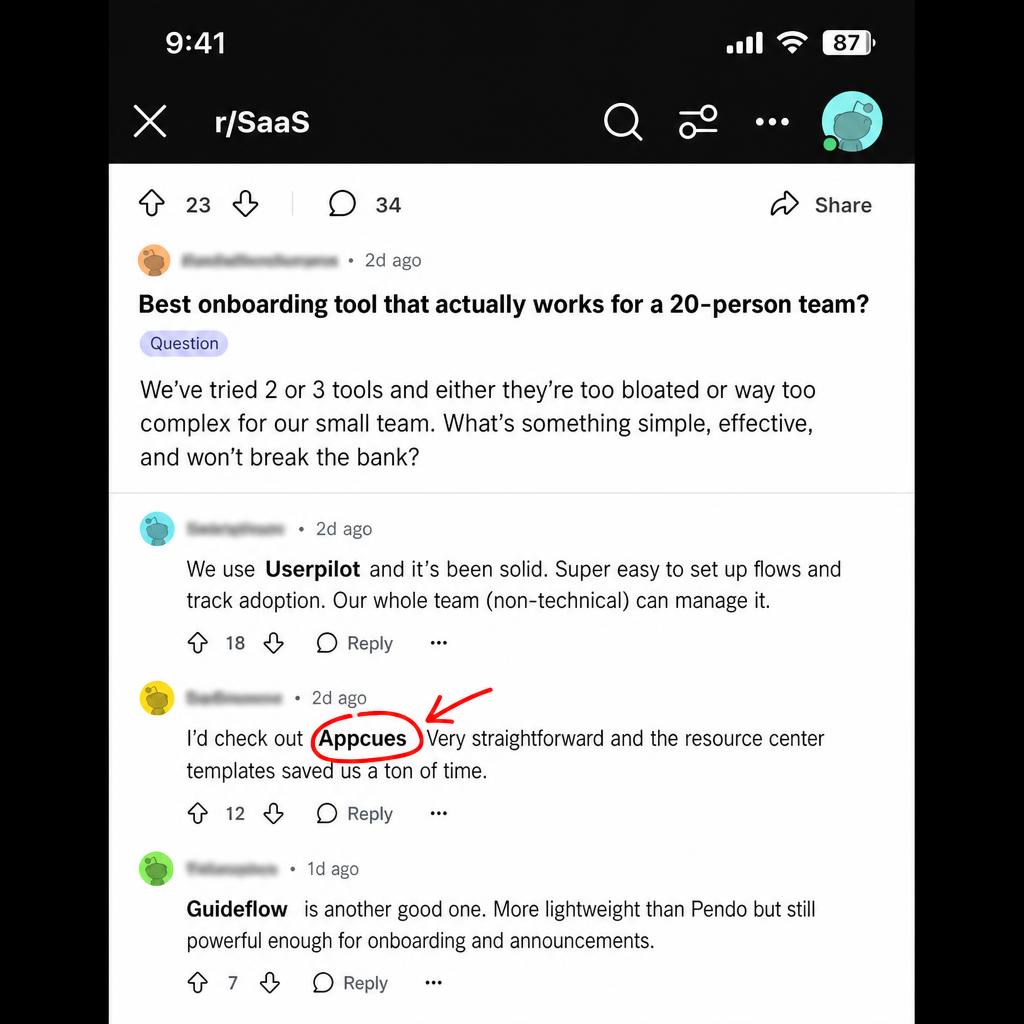
Here’s the important part, and I want to be blunt about it. We do not run fake accounts. We do not astroturf. We do not have an intern paid $6 an hour to post “have you tried [client]?” under every question in r/SaaS. That work is easy to spot, it gets caught, and when it gets caught it poisons the exact graph you’re trying to build. It also, quietly, makes the founder’s life worse, which is not a trade we’re willing to make.
What we do instead is much less glamorous. We find the conversations already happening in your category. We equip your customers, your operators, and your genuine advocates with the language and context they need to participate honestly. We help the analysts and creators who cover your space discover that you exist and are worth writing about. We turn the on-record wins you already have — a great review, a case study, a product launch — into artifacts that other people actually want to cite.
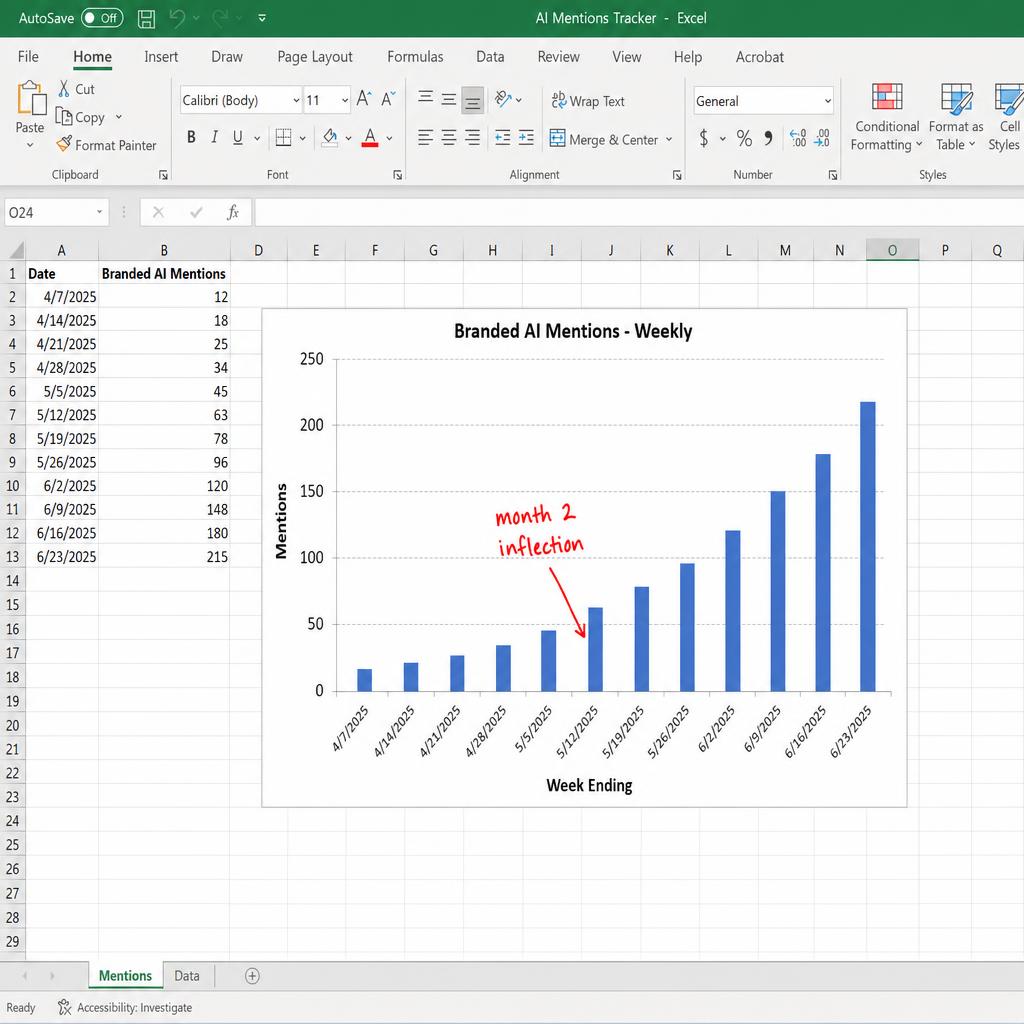
Illustration: a simple weekly bar chart of branded AI mentions climbing from a low double-digit baseline to a couple hundred a week over roughly eleven weeks, with a hand-scrawled note pointing at the week-six inflection where compounding tends to kick in.
That’s the loop. Each new mention strengthens your entity graph, which makes the on-page work land harder, which earns you more citations, which seeds more conversation, which produces more mentions. The reason the third client for a good GEO program always looks easier than the first isn’t luck. It’s that by then, the model is already halfway convinced.
✦Operator's takeaway
One honest mention in a trusted community beats ten polished testimonials on your own site. GEO compounds when the conversation is real.
How this is different, in one table
SEO gets you clicked. GEO gets you named.
The single most common question we get on a first call is: “isn’t this just SEO with new vocabulary?” It isn’t. Here is what actually changes, side by side, so you can see where the two disciplines overlap and where they part ways.
The honest read: if you already have a working SEO program, keep it. GEO doesn’t replace it. It sits next to it and takes the top-of-funnel share that used to arrive as an organic click and now arrives as a name in an answer. You’re not choosing between the two. You’re making sure the newer, faster-growing surface actually has your brand on it.
The quiet math
Every week you’re not in the answer, someone else is being introduced to your buyer.
There are more than 500 million AI search queries every week and the number keeps climbing. In most B2B categories, a meaningful share of new opportunities now begins inside a chat window you can’t see, with an answer you didn’t write, naming vendors you didn’t pick.
This isn’t a “future of search” conversation anymore. It’s a market share conversation. Being invisible in AI answers is the same, financially, as being delisted from a search engine that captures a growing chunk of your top of funnel. Quietly, and without a warning email.
45 days
Average time to first qualified AI-cited lead
3.8x
Increase in branded AI mentions for growth-stage clients
500M+
AI search queries every week — and rising
Who’s behind this
I’m Michal. I built Red-engage because I got tired of watching good B2B brands get quietly erased.
I started Red-engage in 2024 after months of running the same test with different founders and watching the same look cross their face. Good products. Real customers. Not in the answer.
We are a small, deliberate team of GEO strategists, LLM specialists and writers. We take on a limited number of B2B brands each quarter, and we work as an extension of your team — not as another vendor asking you to fill in a brief. Nine active clients right now. Five stars on Clutch. 4.8 on G2. That’s the whole pitch.
— Michal Hajtas, Founder, Red-engage
What the work actually produces
Five case studies from the last twelve months.
Numbers below are from real engagements. Each one started the same way — a live audit that showed the client where their brand was, and wasn’t, in the answers their buyers were getting.
GEO · Marketing agency
189.6%
Increase in organic visibility
A growing marketing agency wanted more qualified traffic and stronger brand recognition. GEO, content strategy, and authority building lifted organic visibility 189.6% and grew branded search demand alongside it.
GEO · Professional kitchen supplies
65.8%
More AI citations across ChatGPT, Gemini, Perplexity and Google AI Overviews
A kitchen supplies brand wanted to appear more often when buyers asked AI for recommendations. Our GEO program lifted AI citations 65.8% and pulled in more high-quality backlinks and brand mentions in the same window.
GEO · Marketing agency
172%
Growth in AI visibility in 90 days
Over a single quarter, this brand grew its presence across ChatGPT, Gemini, Perplexity and Google AI Overviews by 172% — strengthening its positioning inside a crowded category.
GEO · Health & wellness
55.7%
More organic search traffic in one month
A health and wellness brand outmatched by larger competitors grew organic search traffic 55.7% in a single month through topical authority building and citation-ready content.
Community-led · Cybersecurity
1M+
Organic reach without paid ads
A cybersecurity brand reached more than a million people through strategic content distribution, search visibility and community-driven growth — no paid spend attached.
“Measured, brand-safe execution with reporting tied to outcomes. A reliable growth partner.”
A done-for-you GEO engagement, tailored to your brand — not a template rented to twenty others.
Every engagement starts the same way: we look at how the major models currently describe you, where the gaps are, and which citations are within reach in the next quarter. From there, your engagement is custom. Your niche, your buyers, your language, your competitive graph.
Technical GEO
Schema, entity graph, llms.txt, citation-ready content structure. Everything a model needs to describe you correctly.
Citation building
Targeted work on the sources models trust most when constructing answers in your category, done without spam or fake wins.
Reporting that ties to leads
Weekly reporting on AI mentions, sentiment, and pipeline — the numbers you can actually show a CEO or an investor.
Investment
Engagements are quoted per brand based on category, competitive graph, and speed to first citations. Most clients see this as replacing part of an existing SEO or PR line item, not adding to it — because it’s aimed at the channel their buyers have already moved to.
Our commitment. We monitor performance from week one and adjust strategy in real time. If AI visibility hasn’t moved on the metrics we agreed to inside the first 30 days, we keep working — unbilled — until it does.
Take the next step
Book a 30-minute GEO strategy call.
We’ll run the same test we ran for that founder in the opening of this piece — live, on your brand — and show you exactly where you stand in the answers your buyers are getting right now.
On the call
— A live audit of how ChatGPT, Perplexity and Gemini currently describe you.
— The three citations most within reach in the next 45 days.
— A candid read on whether Red-engage is the right partner — or not.
SEO optimizes for a person clicking a link. GEO optimizes for a model choosing which brand to name in its answer. They overlap in places, but the work, the signals and the reporting are different. Most of our clients keep an SEO program running; we work alongside it.
How quickly will we see results?+
Most clients see initial AI-mention movement within 2–3 weeks. First qualified AI-cited leads typically arrive around the 45-day mark. Compounding results build from there, as your entity graph strengthens.
Do we need to change our website?+
In most cases we make targeted additions rather than a redesign — structured data, entity content, an llms.txt, and a small number of citation-ready pages. You keep your existing site, brand and CMS.
Can you work alongside our current agency or in-house team?+
Yes. We integrate with your stack and processes, either as an extension of your team or alongside existing partners. GEO is close enough to SEO that they can share a program without stepping on each other.
What if results don't meet expectations?+
We monitor performance from week one and adjust in real time. If you're not satisfied within the first 30 days, we keep working with you until we hit the agreed goals.
Is this a fit for our stage?+
We work best with B2B SaaS and ecommerce brands that already have a product in-market, real customers, and enough demand to make AI visibility a lever rather than a lottery ticket. If that's you, this works. If not, we'll say so on the call.
If you read this far, you already suspect the same thing we do: the way your buyers find you has changed, and the playbook that got you here isn’t the one that gets you into the next set of answers.
You don’t need to figure this out alone, and you don’t need to bet the year on it. Book the call. Run the test with us. If it’s a fit, we’ll show you exactly what the next 90 days look like. If not, you’ll walk away with a clearer map of your category than most of your competitors will have this year.
The uncomfortable part of this shift isn’t the technology. It’s that AI answers are being written right now, in your category, without you in them — and every week you wait, another buyer gets introduced to a competitor as if they were the obvious choice. The audit is free. The call is 30 minutes. The cost of staying invisible is the one that keeps compounding.
The 30-second AI visibility audit
See what you stand to gain when AI starts naming you.
Four questions. A live estimate of the pipeline you’re leaving on the table by being invisible in AI answers.
Question 1 of 4
When a best-fit buyer asks ChatGPT for a top pick in your category, how often are you named?